

Imagine you’re sitting in an eye clinic, feeling a mix of hope and anxiety about your upcoming cataract surgery. You want the best possible outcome, and that’s where the IOL calculator comes into play.
This tool is not just for surgeons; it’s invaluable for patients like you. If you’re preparing for cataract surgery, understanding your options for intraocular lenses (IOLs) is crucial. The IOL calculator takes various measurements, such as the curvature of your cornea and the length of your eye, to help doctors determine the most suitable lens for your specific needs.
But it’s not just for those with cataracts. Even if you’re looking to correct refractive errors after surgery, the IOL calculator can guide the way. So, whether you’re a first-time patient or revisiting after a previous procedure, this tool can provide clarity.
Ultimately, the IOL calculator empowers you to make informed choices about your vision health, giving you a path toward clearer sight and a brighter future.
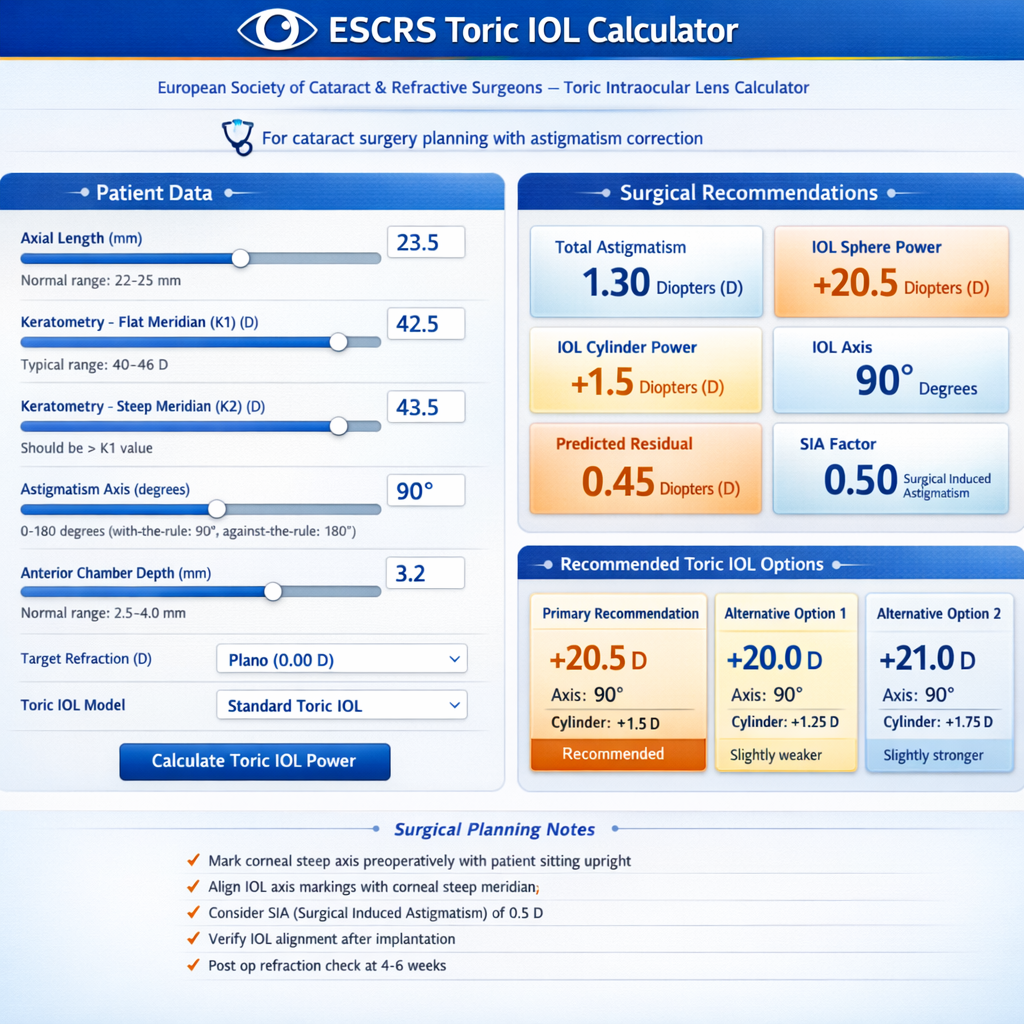
ESCRS Toric IOL Calculator
European Society of Cataract & Refractive Surgeons – Toric Intraocular Lens Calculator
Patient Data
Surgical Recommendations
Recommended Toric IOL Options
Surgical Planning Notes
- Mark corneal steep axis preoperatively with patient sitting upright
- Align IOL axis markings with corneal steep meridian
- Consider SIA (Surgical Induced Astigmatism) of 0.5 D
- Verify IOL alignment after implantation
- Post-op refraction check at 4-6 weeks
