

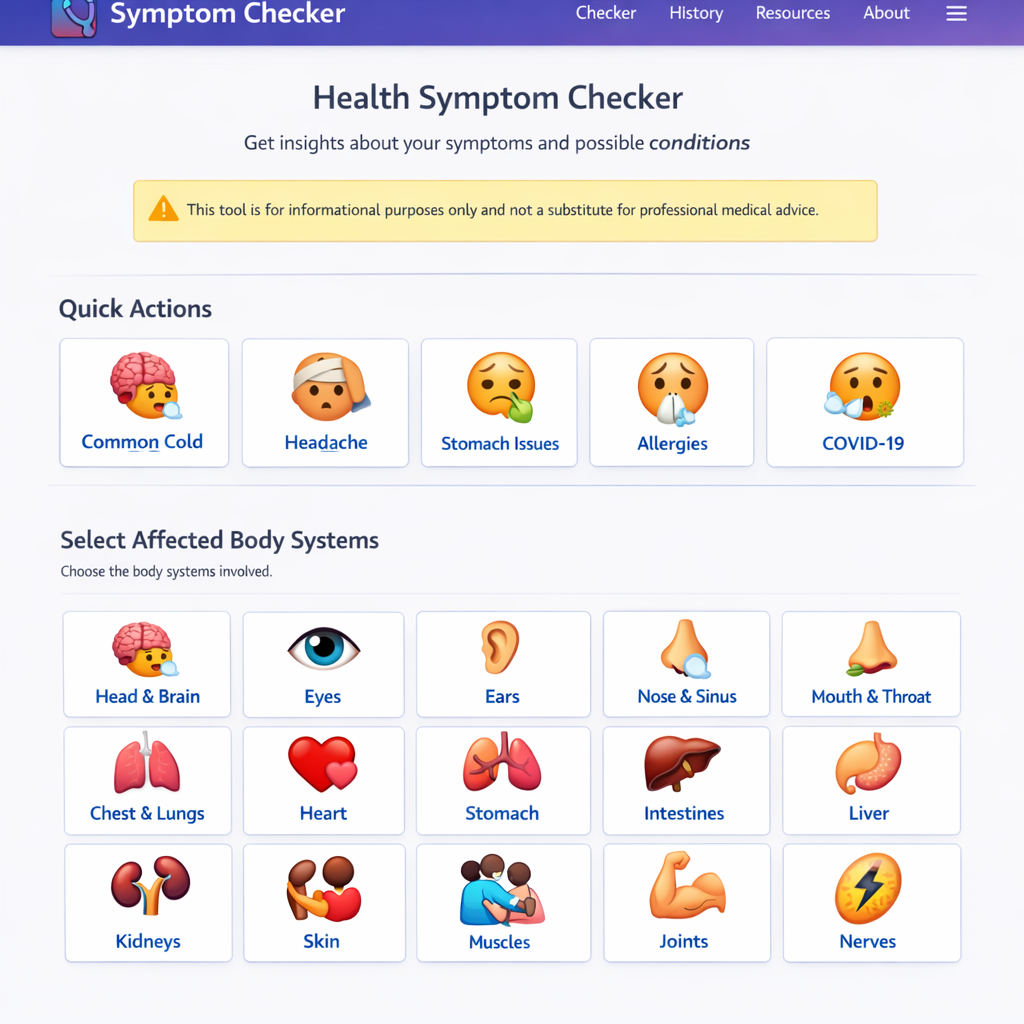
Multi-symptom checkers are essential digital tools that help individuals assess health concerns by evaluating multiple symptoms simultaneously.
These innovative applications use complex algorithms to match user-entered symptoms to a comprehensive database of diseases and conditions, guiding users toward potential diagnoses.
From common ailments to chronic conditions, these checkers enhance health literacy by providing actionable insights and information, allowing for informed discussions with healthcare providers.
When choosing a multi-symptom checker, consider features such as user interface, database coverage, medical accuracy, and data privacy.
This blog post explores the benefits of multi-symptom checkers, highlights top tools available, and provides best practices for effective use, empowering individuals to take charge of their health and make informed healthcare decisions.
Health Symptom Checker
Get insights about your symptoms and possible conditions
Select Affected Body Systems
Select Your Symptoms
Symptom Details
Additional Information
Analyzing your symptoms…
Analysis Results
Based on your symptoms, here are possible conditions
Recommendations
Recent Checks
Table of Contents
Understanding Multi-Symptom Checkers
Multi-symptom checkers are innovative digital tools designed to assist individuals in assessing their health conditions by evaluating multiple symptoms simultaneously.
Their primary purpose is to provide users with an initial insight into possible health concerns, thereby facilitating a more informed conversation with healthcare professionals. As online health resources have proliferated, multi-symptom checkers have emerged as a valuable tool in the realm of personal health management.
The technology behind these checkers typically involves algorithms that analyze the symptoms input by the user. Most platforms utilize a comprehensive database of diseases and symptoms, applying medical knowledge and statistical models to generate potential diagnoses.
As users input their specific symptoms, the system cross-references these with existing medical literature and case studies, offering a list of possible conditions that may be causing the symptoms.
This technology enables users to explore various health issues in-depth and provides a more structured approach to discussing symptoms with healthcare providers.
Multi-symptom checkers evaluate a wide range of symptoms, from common ailments like colds and flu to more complex health issues such as chronic conditions. This versatility allows users to gain insights regardless of their symptoms’ severity. Moreover, these tools often include educational resources that inform users about various health conditions, enhancing overall health literacy.
The benefits of using multi-symptom checkers are manifold. They can demystify vague health concerns and empower users by offering preliminary insights into what may be occurring with their bodies.
Furthermore, by promoting proactive health management, they encourage individuals to seek appropriate medical advice when necessary, ultimately contributing to better health outcomes. In this fast-paced digital age, multi-symptom checkers play a crucial role in bridging the gap between symptom recognition and appropriate medical intervention.
Features to Look for in a Multi-Symptom Checker
When evaluating a multi-symptom checker, there are several essential features to consider to ensure the tool meets your health needs effectively. One of the first factors to examine is the user interface. A user-friendly interface enhances the experience by allowing users to navigate seamlessly through the platform, making it easier to enter symptoms and obtain accurate results.
Another crucial aspect is the comprehensiveness of the symptom database. An effective multi-symptom checker should provide an extensive list of symptoms, conditions, and potential diagnoses. This ensures that users can input a wide range of symptoms, increasing the likelihood of receiving relevant and precise information. Furthermore, the accuracy of the medical content is vital.
The tool should rely on information derived from reputable medical sources, enhancing the quality and reliability of recommendations.
The quality of recommendations is equally important. A great multi-symptom checker not only identifies potential health issues but also provides actionable insights and suggestions for follow-up care. This can significantly aid users in deciding whether to seek medical attention or manage their symptoms at home.
Additionally, attention to data privacy is paramount; users should feel secure knowing that their health information is protected. Opt for tools that adhere to stringent data protection regulations and ensure confidentiality.
Lastly, mobile accessibility is an essential feature in today’s technology-driven world. A multi-symptom checker that offers a well-designed mobile app or a mobile-friendly website can greatly enhance the user experience, enabling individuals to access vital health information on the go.
In summary, assessing these features—user interface, database comprehensiveness, medical accuracy, recommendation quality, data privacy, and mobile accessibility—will empower users to choose the most effective multi-symptom checker tailored to their needs.
Top Multi-Symptom Checkers on the Market
In today’s digital age, multi-symptom checkers have become essential tools for individuals seeking medical advice. These applications not only serve to evaluate symptoms but also aid users in making informed decisions regarding their health care. Among the leading platforms, several stand out for their effectiveness and user satisfaction.
One prominent checker is WebMD Symptom Checker. This tool offers a user-friendly interface, allowing individuals to input their symptoms quickly and receive tailored recommendations. WebMD has a strong reputation backed by a team of medical experts, leading many users to trust its suggestions. However, some critiques point to the possibility of over-diagnosing conditions, which could induce unnecessary anxiety.
Another notable mention is Symptomate. It distinguishes itself with a sleek design and an algorithm that mimics the questions a healthcare professional might ask. A significant advantage of Symptomate is its multilingual support, making it accessible to non-English speakers.
Users appreciate its detailed information on various conditions and treatment advice. On the downside, some users report experiencing occasional inaccuracies in symptom predictions.
Buoy Health is also a contender in this space. It utilizes an AI-driven approach to deliver tailored health assessments based on user input. Buoy focuses on guiding users toward appropriate care options, which many find helpful. However, its reliance on technology may result in less personalized advice for complex health issues.
Lastly, Healthline Symptom Checker excels in delivering in-depth articles and reliable health content alongside its symptom evaluation feature. Its integration of information and user support makes it a comprehensive tool for individuals wary of their health concerns. Like others, it has faced feedback regarding the limits of its diagnostic capabilities.
In evaluating these multi-symptom checkers, users should consider their individual needs and preferences. Each tool offers unique features along with strengths and weaknesses that cater to diverse user bases.
Using a Multi-Symptom Checker: Tips and Best Practices
Multi-symptom checkers can serve as valuable tools for individuals seeking to understand their health conditions better. To maximize the effectiveness of these tools, it is crucial to follow specific best practices when using them. First and foremost, accurately inputting symptoms is essential.
Users should take their time to list all relevant symptoms without omitting minor details, as even small indicators can significantly influence the results. Ideally, users should reflect on the nature, duration, and severity of each symptom before entering them into the checker.
Another critical aspect is understanding how to interpret the results provided by a multi-symptom checker. These checkers often use algorithms to suggest possible conditions based on the symptoms entered. While these suggestions can be informative, they are not definitive diagnoses.
It is advisable to approach the results with a critical mindset, recognizing that a variety of factors can impact health, and most checkers cannot account for personal medical history or nuanced symptoms.
It is also important to recognize the limitations of a multi-symptom checker as a diagnostic tool. While they can be a helpful first step in assessing health concerns, the tools cannot replace professional medical advice.
Users should consider contacting healthcare professionals if symptoms are severe, persistent, or accompanied by alarming signs, such as significant weight loss or difficulty breathing. In such cases, seeking immediate medical attention is paramount.
In conclusion, utilizing a multi-symptom checker effectively entails entering detailed symptom information, interpreting results carefully, and knowing when to seek professional guidance. By following these best practices, individuals can make informed health decisions and enhance their overall understanding of their health conditions.
What is a symptom?
A symptom is a subjective experience you report — like pain, fatigue, or nausea — that signals a possible change in health.
What is the best app to track multiple symptoms?
The best app is the one that fits your needs — look for customizable symptom lists, tags for triggers/meds, graphs, reminders, export/sharing options, and strong privacy controls.
What are the types of symptoms?
They’re often grouped as physical (e.g., pain), cognitive (e.g., brain fog), emotional (e.g., anxiety), and behavioral (e.g., sleep changes), and described by timing (acute/chronic), pattern (intermittent/persistent), and severity.
How do I choose a symptom-tracking app?
Prioritize ease of use, quick logging, customizable trackers, trend charts, reminders, data export (PDF/CSV), clinician-friendly summaries, and transparent data policies.
Can I share my symptom logs with my healthcare provider?
Yes — many apps let you export summaries or connect to patient portals; bring concise trend charts and key events to appointments.
