

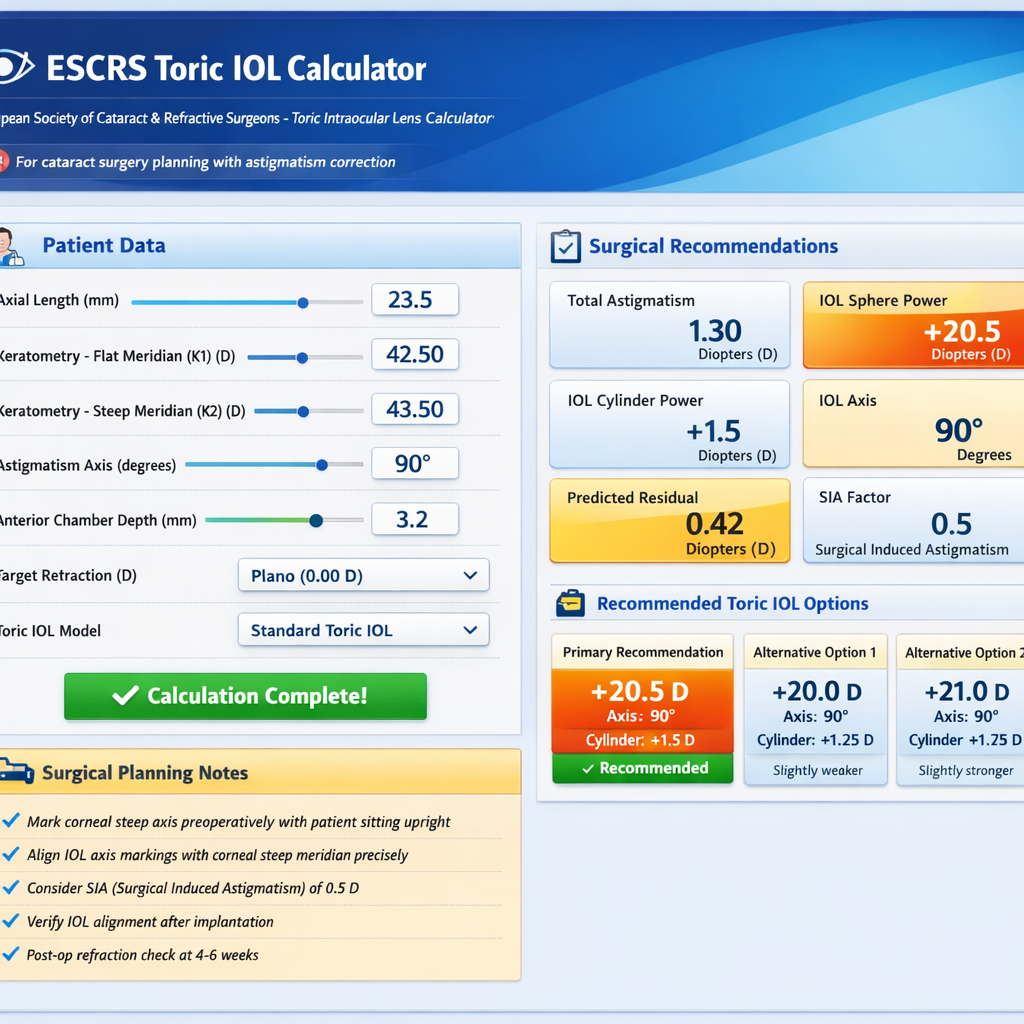
When I first encountered the ESRs calculator for toric lenses, I was completely overwhelmed. I had recently undergone cataract surgery and my surgeon had mentioned the importance of getting the right toric lens to correct my astigmatism. They handed me this calculator and told me it would help ensure I got the best possible outcome, but to be honest, it felt like a complex math problem that I hadn’t signed up for.
After some frustrating moments of scrolling through the options and trying to make sense of the numbers, I realized that the ESRs calculator is designed to take specific measurements of your eye, such as the corneal curvature and the desired lens position. I remember sitting at my kitchen table, scribbling down notes and referring to my preoperative measurements, trying to align everything properly. Eventually, the process became clearer, and I understood how crucial it was for customizing my lens to target my unique vision needs. Now, looking back, I’m grateful for the detailed approach; it made a significant difference in my post-surgery vision.
ESCRS Toric IOL Calculator
European Society of Cataract & Refractive Surgeons – Toric Intraocular Lens Calculator
Patient Data
Surgical Recommendations
Recommended Toric IOL Options
Surgical Planning Notes
- Mark corneal steep axis preoperatively with patient sitting upright
- Align IOL axis markings with corneal steep meridian
- Consider SIA (Surgical Induced Astigmatism) of 0.5 D
- Verify IOL alignment after implantation
- Post-op refraction check at 4-6 weeks
