
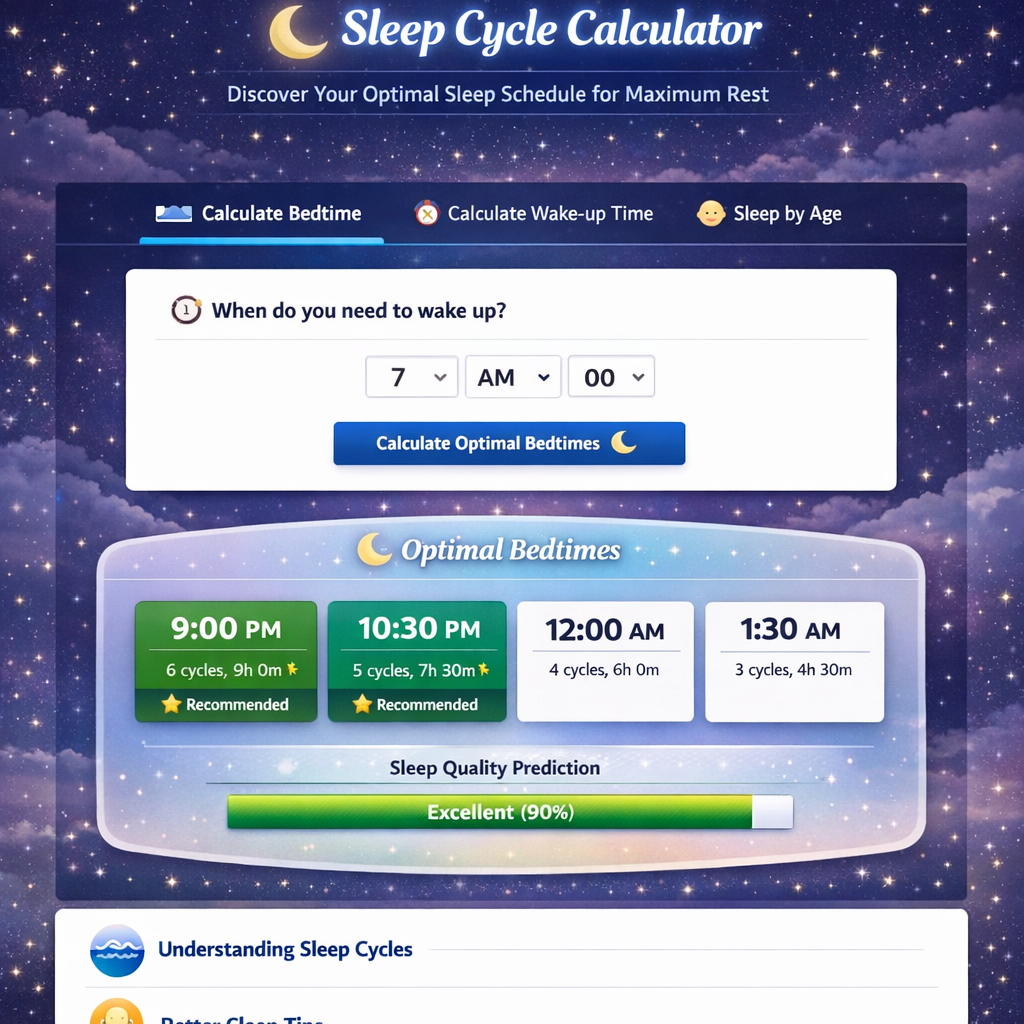
Unlock the power of the Sleep Calculator! Maximize your rest by calculating ideal bedtimes and wake-up times based on your sleep cycles.
Sleep Cycle Calculator
Discover Your Optimal Sleep Schedule for Maximum Rest
🕐 When do you need to wake up?
🕐 When are you going to bed?
Select Your Age Group:
Recommended Sleep Duration: 7-9 hours
Young adults (18-25) should aim for 7-9 hours of sleep per night. This is crucial for cognitive development, emotional regulation, and physical health.
Optimal Sleep Times
Sleep Quality Prediction
Understanding Sleep Cycles
Sleep Cycle Duration
Each sleep cycle lasts approximately 90 minutes, moving through light sleep, deep sleep, and REM sleep. Waking at the end of a cycle helps you feel refreshed.
REM Sleep
Rapid Eye Movement sleep is when dreaming occurs and your brain processes emotions and memories. It makes up about 25% of your sleep time.
Deep Sleep
Also known as slow-wave sleep, this is when your body repairs tissues, builds bone and muscle, and strengthens the immune system.
💡 Better Sleep Tips
Consistent Schedule
Go to bed and wake up at the same time every day, even on weekends. This regulates your body’s internal clock.
Create a Routine
Develop relaxing pre-sleep activities like reading, gentle stretching, or meditation to signal your body it’s time to sleep.
Optimize Environment
Keep your bedroom cool (60-67°F), dark, and quiet. Use blackout curtains, earplugs, or a white noise machine if needed.
Limit Screens
Avoid phones, tablets, and computers 1-2 hours before bed. Blue light suppresses melatonin production.
Watch Your Diet
Avoid caffeine, alcohol, and heavy meals within 3 hours of bedtime. A light snack is okay if you’re hungry.
Exercise Regularly
Regular physical activity helps you fall asleep faster and enjoy deeper sleep, but avoid vigorous exercise close to bedtime.
Table of Contents
🌙 Introduction: Are You Waking Up Tired?
Do you ever find yourself waking up feeling groggy and unrested, even after a full 8 hours of sleep? Or perhaps you’ve experienced those rare mornings when you wake up feeling refreshed and energized, ready to tackle the day? The difference between these scenarios often comes down to one crucial factor: timing
Welcome to the fascinating world of sleep cycles – the natural rhythm that governs how we rest and recover. By understanding and working with these cycles, you can transform your relationship with sleep and wake up feeling your best every single day.
🧠 What Are Sleep Cycles?
Sleep isn’t a flat line of unconsciousness. Instead, it’s a dynamic journey through different stages, each serving unique purposes for your body and brain. A complete sleep cycle lasts approximately 90 minutes and consists of four distinct stages:
Stage 1: Light Sleep (1-7 minutes)
- The transition period between wakefulness and sleep
- Your muscles relax, and your breathing slows
- Easy to wake from during this stage.
Stage 2: Deeper Sleep (10-25 minutes)
- Your brain waves slow down
- Body temperature drops
- Heart rate and breathing regulate
- You spend about 50% of your sleep time here
Stage 3: Deep Sleep (20-40 minutes)
- Also known as slow-wave or delta sleep
- Critical for physical recovery and growth
- Difficult to wake from during this stage
- When your body repairs tissues and builds bone/muscle.
Stage 4: REM Sleep (10-60 minutes)
- Rapid Eye Movement sleep
- When most dreaming occurs
- Essential for memory consolidation and emotional processing
- Your brain is highly active, similar to when you’re awake.
Throughout the night, you typically complete 4-6 of these 90-minute cycles, with REM periods getting longer in later cycles.
⏰ The Magic of Timing: Why Wake-Up Time Matters
Here’s where the science gets practical: waking up in the middle of a deep sleep cycle is what causes that dreaded sleep inertia – that groggy, disoriented feeling that can last for hours. However, waking up at the end of a cycle, during lighter sleep, allows you to rise feeling refreshed and alert.
This explains why you might feel better after 6 hours of sleep than after 8 hours. If 6 hours aligns with completing four full sleep cycles (4 × 90 = 360 minutes), while 8 hours leaves you waking up in the middle of a fifth cycle’s deep sleep phase, the shorter duration actually serves you better.
🧮 The Mathematics of Perfect Sleep
Using a sleep cycle calculator takes the guesswork out of optimal sleep timing. Here’s how it works:
Calculating Your Ideal Bedtime:
- Start with your desired wake-up time
- Subtract 90 minutes for each sleep cycle you want to complete
- Subtract an additional 15 minutes for the time it typically takes to fall asleep
- The result gives you several optimal bedtime options.
Example: If you need to wake up at 7:00 AM:
- 6 cycles (9 hours): Bedtime at 9:45 PM.
- 5 cycles (7.5 hours): Bedtime at 11:15 PM
- 4 cycles (6 hours): Bedtime at 12:45 AM
- 3 cycles (4.5 hours): Bedtime at 2:15 AM.
Calculating Your Ideal Wake-up Time:
- Start with your planned bedtime
- Add 15 minutes for sleep onset.
- Add 90-minute increments for each sleep cycle
- The results show your optimal wake times
👶 Sleep Needs Across the Lifespan
Sleep requirements vary significantly throughout our lives. Here’s what science recommends:
Newborns (0-3 months): 14-17 hours
- Sleep occurs in short bursts around the clock
- Essential for rapid brain development
Infants (4-11 months): 12-15 hours
- Sleep patterns begin to consolidate
- Critical for growth and learning
Toddlers (1-2 years): 11-14 hours
- Regular sleep schedules become important
- Supports cognitive and physical development
Preschoolers (3-5 years): 10-13 hours
- Sleep needs remain high but begin to decrease
- Important for emotional regulation
School-age Children (6-13 years): 9-11 hours
- Sleep becomes more consolidated to nighttime
- Crucial for learning and memory
Teenagers (14-17 years): 8-10 hours
- Circadian rhythms naturally shift later
- Often sleep-deprived due to early school schedules
Young Adults (18-25 years): 7-9 hours
- Optimal range for cognitive performance
- Important for establishing lifelong habits.
Adults (26-64 years): 7-9 hours
- Consistent sleep timing becomes crucial
- Quality matters as much as quantity
Older Adults (65+ years): 7-8 hours
- Sleep may become lighter and more fragmented
- Regular sleep schedule remains important
❌ Common Sleep Timing Mistakes
Even with the best intentions, many people make these timing errors:
1. The “I’ll Make It Up Tomorrow” Fallacy
You can’t bank sleep or recover from sleep debt with one long night. Consistency is key.
2. Weekend Sleep Whiplash
Staying up late and sleeping in on weekends disrupts your circadian rhythm, making Monday mornings brutal..
3. The “Just One More Episode” Trap
That extra episode might push you into the middle of a sleep cycle, making you groggy tomorrow.
4. Ignoring Your Sleep Onset Time
Forgetting to account for the 15-30 minutes it takes to actually fall asleep can throw off your entire calculation.
5. The Power Nap Misconception
While naps can be beneficial, timing them wrong (too long or too late) can disrupt your nighttime sleep cycles.
🌟 The Benefits of Cycle-Based Sleep
When you start aligning your sleep schedule with your natural cycles, you’ll notice:
Immediate Benefits:
- Easier morning wake ups.
- Reduced grogginess and sleep inertia
- Better mood upon waking
- Increased morning energy.
Short-term Benefits (1-2 weeks):
- Improved daytime alertness.
- Better concentration and focus
- Enhanced decision-making
- Reduced caffeine dependence.
Long-term Benefits (1+ months):
- Stronger immune system
- Better weight management
- Improved memory and learning.
- Reduced risk of chronic diseases
- Enhanced athletic performance.
- Better emotional regulation
- Increased longevity
🛠️ Practical Implementation Guide
Ready to optimize your sleep? Here’s your step-by-step action plan:
Week 1: Calculate and Experiment
- Use a sleep cycle calculator to determine your optimal bedtime/wake times
- Try different cycle numbers (3-6 cycles) to find what feels best
- Keep a simple sleep journal to track how you feel each morning.
Week 2: Establish Consistency
- Choose your optimal sleep schedule and stick to it
- Set reminders for 30 minutes before bedtime to start winding down
- Create a consistent pre-sleep routine.
Week 3: Optimize Your Environment
- Ensure your bedroom is cool (60-67°F).
- Block out all light sources
- Minimize noise or use white noise
- Remove screens from the bedroom
Week 4: Fine-Tune and Maintain
- Adjust your schedule based on how you feel
- Address any remaining sleep issues
- Establish this as your long-term routine
🎯 Advanced Tips for Sleep Cycle Optimization
Once you’ve mastered the basics, try these advanced strategies:
1. The Sleep Cycle Power Nap
Take 20-25 minute naps to complete one sleep cycle without entering deep sleep, leaving you refreshed.
2. The Strategic Weekend
If you must stay up late, wake up at your normal time and take a 90-minute nap the next day to complete a full cycle.
3. The Jet Lag Reset
When traveling across time zones, use sleep cycle calculations to adjust your schedule gradually.
4. The Early Bird Special
Some people naturally function better with earlier bedtimes. Experiment with moving your entire schedule earlier.
5. The Night Owl Optimization
If you’re naturally a night owl, embrace it but still cycle your sleep appropriately.
📱 Technology and Sleep Cycles
Modern technology can both help and hinder your sleep cycle optimization:
Helpful Tools:
- Sleep tracking apps that monitor your cycles
- Smart alarms that wake you during light sleep
- Blue light filtering apps for evening screen use
- White noise machines and apps
Potential Hindrances:
- Late-night screen time disrupting melatonin
- Notifications interrupting sleep cycles
- Blue light exposure suppressing sleep hormones
- The temptation to scroll instead of sleep
🔬 The Science Behind Sleep Cycle Calculations
The 90-minute sleep cycle is based on extensive research, but individual variations exist:
- Cycle Duration: Can range from 70-120 minutes
- Sleep Onset: Some people fall asleep in 5 minutes, others need 30+
- Cycle Distribution: Deep sleep dominates early cycles, REM dominates later ones
- Individual Variation: Genetics, age, and lifestyle affect your patterns
This is why personal experimentation is crucial use the calculations as a starting point, then fine-tune based on your body’s responses.
🌈 Conclusion: Your Journey to Perfect Sleep Begins Tonight
Understanding and working with your sleep cycles isn’t just about feeling less tired – it’s about unlocking your full potential. When you’re well-rested, you think more clearly, perform better at work, maintain healthier relationships, and enjoy life more fully.
The beauty of sleep cycle optimization is that it’s both scientifically grounded and immediately practical. You don’t need expensive equipment or complex routines just a basic understanding of your body’s natural rhythms and the willingness to work with them rather than against them.
Tonight, take the first step. Calculate your optimal bedtime based on when you need to wake up tomorrow. Set a reminder to start winding down 30 minutes before that time. Put away your screens, dim the lights, and prepare for a night of perfectly timed rest.
Tomorrow morning, notice the difference. That refreshed, energized feeling? That’s your reward for working with your body’s natural wisdom.
Welcome to the world of perfect sleep. Your best days are about to begin.
Ready to optimize your sleep? Try our Sleep Cycle Calculator above to discover your optimal sleep schedule and start your journey to better rest tonight. Your future self will thank you. 🌙✨